Learning to sit with our feelings
 Lyndall Thomas

Unpacking how to sit with our feelings. Inspired by Rumi's poem, The Guest House, with a meditation and plenty of tips.
Were you taught, like me, to supress your feelings rather than feel them? The messages might have been: don’t cry, push through, stay positive, get on with it. Or, even worse, pull your socks up.
If this sounds familiar, you probably recognise the way that, when an uncomfortable feeling arises – sadness, envy, shame, a flash of anger – our instinct is often to shove it down, distract ourselves, or wait for it to pass.
But feelings that we refuse to feel don't disappear. Instead, they tend to resurface later, usually at a less convenient moment, and often at a louder volume.
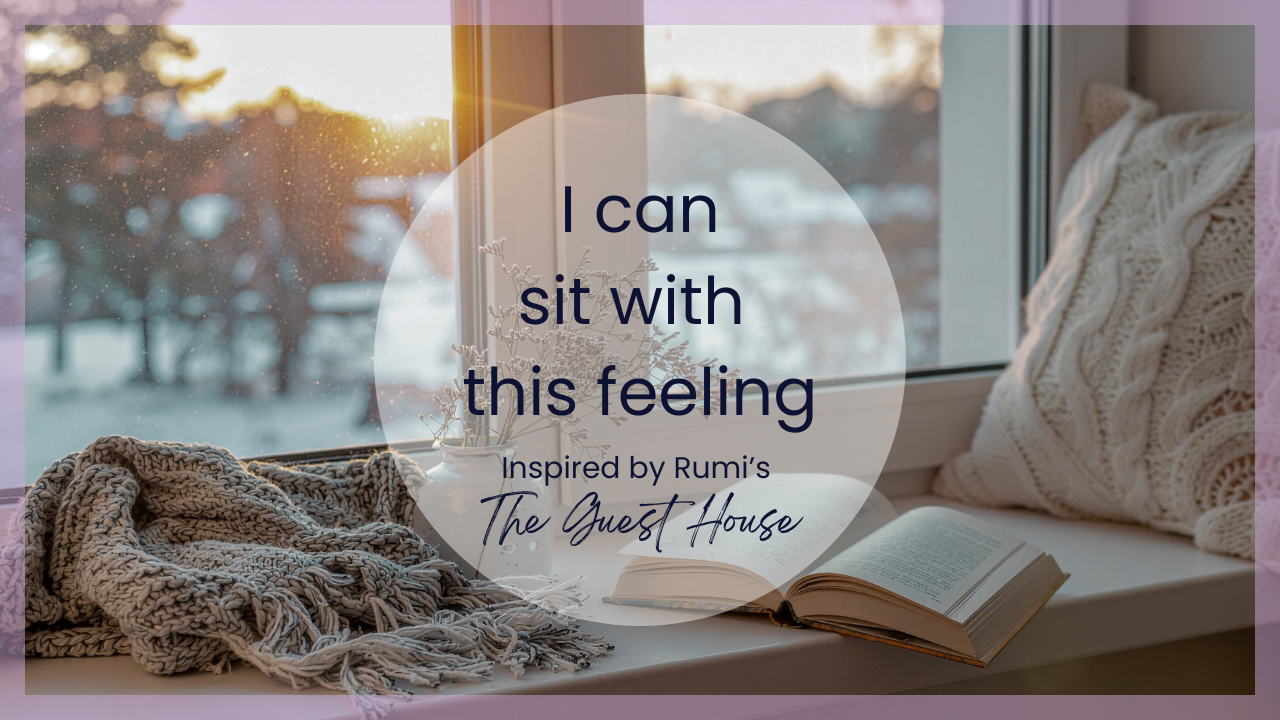
This has been a huge issue for me over the years. And I’ve known for a long time that I’m supposed to ‘sit with my feelings’ – but I haven’t quite known why, or how to do that. So, I developed a meditation called ‘I can sit with this feeling’ to help me do this important work. I’d love you to join me on this journey of self-compassion and self-awareness.
6a13dee9065be_lg.png)
An old idea that’s still true
The practice I have created is based on the well-loved poem The Guest House by the Persian poet Rumi. In it, Rumi compares being human to running a guest house – every morning, new visitors arrive. Some are joyful. Some are difficult. His invitation is to welcome them all, even the ones that unsettle the furniture, because each one has something to teach us.
I love this idea, not because it asks us to enjoy discomfort, but because it gives us permission to stop fighting our feelings. Feelings that we allow in and witness tend to move through us more easily than those we're bracing against.
You can read the full poem, translated by Coleman Barks and shared with his permission, here.
Why sitting with our feelings helps
Beyond the beauty of Rumi’s poetry, there’s science offering insights to encourage us to welcome and sit with our feelings.
The first insight is about what happens when we name a feeling. A well-known study out of UCLA found that when people put a feeling into words, activity eased in the amygdala – the brain's alarm system – while a region involved in calm, considered thinking switched on. Naming what you feel changes what your brain does with it.
The second insights is about what happens when we push a feeling away. A meta-analysis pulling together data from 114 separate studies found that avoidance and suppression were both strongly linked to anxiety, depression and other symptoms, while sitting with and accepting a feeling showed a far weaker link. The strategies that feel instinctive – distract, suppress, don't think about it – are the ones most tied to things getting harder over time.
So, sitting with a feeling isn't just a comforting idea. It has a mechanism with solid data behind it.
Putting it into practice
Sitting with a feeling doesn't mean analysing it or fixing it. It's simpler, and slower, than that. It might look like:
- naming the feeling, even if it doesn't have a tidy label yet
- placing a hand on your heart and breathing into your heart space
- offering yourself a little curiosity instead of judgement
- letting the feeling be there, without rushing it along
- moving towards acceptance.
This is the practice we've built into the meditation. It's not about forcing calm or arriving at an answer. It's about proving to yourself that you can be with a feeling, and come out the other side.
Try the meditation
If this resonates, you can listen to I can sit with this feeling here. It's a gentle place to start, whenever an uncomfortable feeling needs a moment of your honest attention.
May you find your way home to yourself.

References:
Lieberman, M. D. et al. (2007). Putting feelings into words: Affect labeling disrupts amygdala activity in response to affective stimuli. Psychological Science, 18(5), 421–428.
Aldao, A., Nolen-Hoeksema, S. & Schweizer, S. (2010). Emotion-regulation strategies across psychopathology: A meta-analytic review. Clinical Psychology Review, 30(2), 217–237.
Categories: : Meditation